

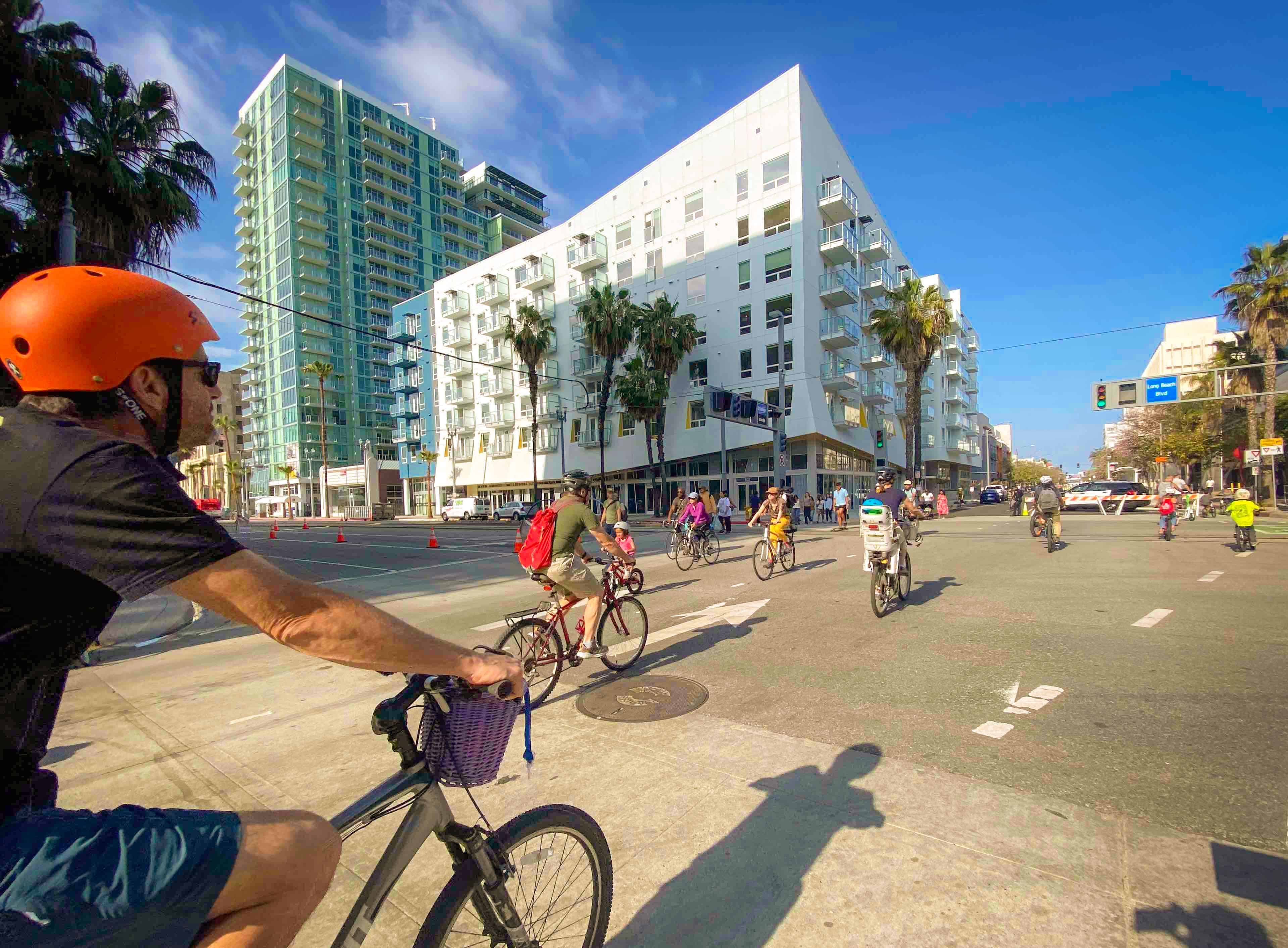
Beach Streets—the City of Long Beach’s removal of vehicles from streets to make way for everyone from bicyclists and skaters to walkers and those in wheelchairs—is a reminder that streets are not merely conduits for cars. They are public spaces. And on Sunday, July 19, from 11AM to 4PM, Long Beach will once again celebrate that philosophy as Beach Streets returns to one of its most beloved routes.
There are few events that so completely transform how Long Beach feels as Beach Streets. For one afternoon, the city’s hierarchy is flipped on its head: automobiles disappear, and the streets—normally dominated by traffic, signals and parking—belong instead to bicyclists, skateboarders, wheelchair users, runners, families with strollers and people simply out for a walk.
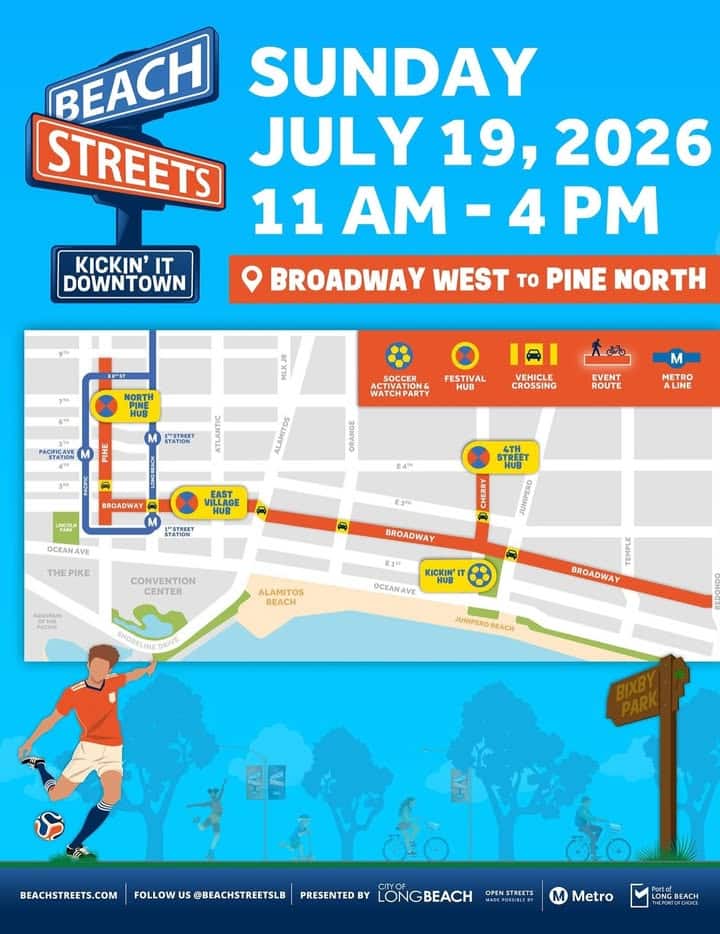
This year’s ciclovía stretches from Downtown Long Beach along Broadway to Bixby Park, with festival hubs at Pine Avenue, the East Village, 4th and Cherry, and Bixby Park itself.
The route is, in many ways, the ideal showcase for what makes Long Beach unique. It connects the dense urban core with historic neighborhoods, passes through thriving commercial corridors filled with independent businesses, links Metro stations with parks and beaches, and invites participants to experience places they often speed past behind a windshield. Broadway itself is one of the city’s most human-scaled streets—a corridor lined with cafés, restaurants, apartments, neighborhood storefronts and historic architecture that feels fundamentally different when stripped of moving traffic.
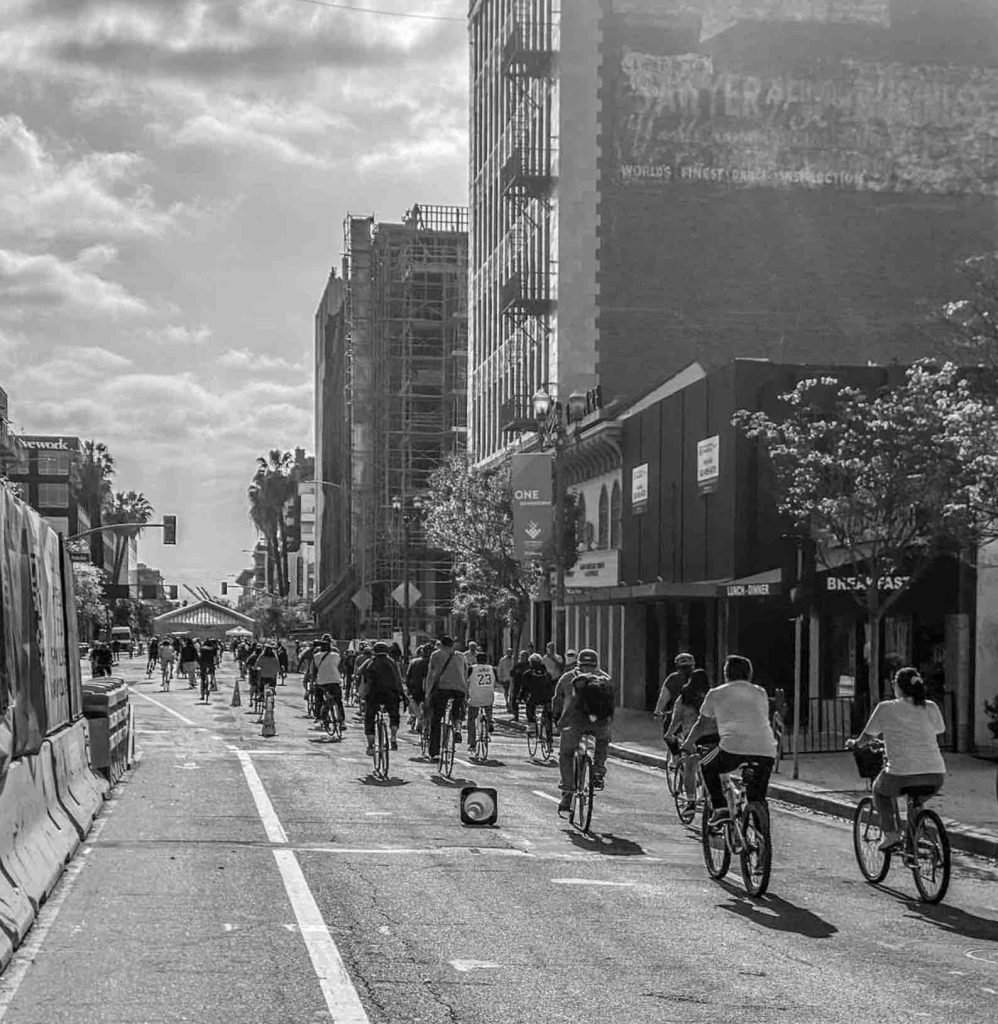
Why the Broadway route for Beach Streets remains its best.
That transformation is precisely what makes this particular Beach Streets route so powerful. Broadway has long embodied the principles of a Complete Street, where multiple forms of transportation coexist alongside active neighborhood life. Closing it to cars for a day doesn’t create something entirely new—it reveals what was already there. Suddenly conversations replace engine noise. Children can ride bicycles without fear. Neighbors linger at intersections that normally exist only as places to hurry through. Businesses spill onto sidewalks. The city slows to a pace where details become visible again.
That slower pace has always been one of the event’s greatest gifts. Walking or riding a bicycle through a city changes your relationship with it. You notice murals you’ve never seen before. Or you stop to chat with strangers. You realize how close neighborhoods actually are to one another. The distance between Downtown and Alamitos Beach shrinks from something measured in minutes behind the wheel to an enjoyable journey filled with storefronts, music, food and unexpected conversations. The destination becomes secondary to the experience itself.
Perhaps no event better illustrates why Complete Streets matter. For decades, American cities prioritized moving as many cars as possible as quickly as possible, often at the expense of everyone else. The idea of Complete Streets asks a different question: What if roads served everyone? What if safety, accessibility, and quality of life mattered as much as vehicle throughput? Beach Streets offers a glimpse into that alternative—not by permanently removing cars, but by allowing residents to experience their city through a different lens for a single day.
Beach Streets isn’t just about bikes. It’s about people and the human scale.
That perspective extends beyond cycling.
A true ciclovía is an invitation to everyone, regardless of how they move. It is as much for someone walking their dog as it is for a seasoned cyclist. It is for children learning to ride, seniors enjoying a leisurely stroll, people using mobility devices who can suddenly occupy the middle of a street without anxiety, and families pushing strollers side by side. Few public events are as inherently inclusive because few require so little beyond simply showing up.
The Broadway route also thrives because of the neighborhoods surrounding it. Downtown, the East Village, Retro Row, Alamitos Beach and Bluff Heights all possess strong identities and vibrant small-business communities that naturally spill into the event. Restaurants set up sidewalk activations or invite you in for some hospitality. Artists display their work or create live murals. Musicians find impromptu audiences as they busk. (RIP, Buskerfest.) Community organizations introduce themselves to residents who might otherwise never encounter them. Beach Streets succeeds not merely because roads are closed, but because neighborhoods enthusiastically fill that space with life.
In a city that continues to invest in bicycle infrastructure, safety improvements, and more equitable streets, Beach Streets serves as both a celebration and a reminder. It celebrates the progress Long Beach has made toward becoming a city less dependent on the automobile while reminding everyone that streets are among our largest public spaces. They are not just transportation infrastructure; they are connectors, both literally and communally.
For five hours on July 19, Broadway will once again become exactly that: not a road to rush through, but a place to gather, explore and remember that cities are ultimately built for people.


They have done this for years in NYC. Really great events in al different burrow every week.
[…] its book launch at the finish line festival in 2014. The city hosts other biking events including Beach Streets where a major route is closed to cars for the […]
This event is in conflict with another ciclavia event in Hollywood/LA. Attendance will be spilt between the two events, VERY POOR PLANING.