

Long Beach Last Call 2026—a 15-event celebration of our city’s bar scene across 10 days—saw hundreds upon hundreds of people pour out to honor one of the most thankless industries: those that work behind our bars and create our cocktails. While organizing it, I would be remiss not to include this as a personal thank-you. After all, this year’s celebration—one that combined consumer-based, industry-specific, and educational events—was indeed one of the best collaborations involving me, Visit Long Beach, my partner Samuel Cornejo, and countless folks in the industry.
This iteration was particularly special: spaces were more involved, events were more streamlined, and 2026 is going to prove, much like the restaurant industry, one of the roughest for the bar industry. (More on that in a second.) And because of that, I must reemphasize: Long Beach Last Call was and will always be an ode to an industry that is often not given the light it deserves. So the name “Last Call” has a double meaning: Yes, last call is when bartenders pour their last drink, but the bar industry is also the last to be called on in the name of recognition.

Why the bar industry is under pressure…
The American bar industry is navigating one of its most complicated periods in decades: rising costs, unstable supply chains, shrinking alcohol consumption among younger consumers, and deep structural changes in wine and spirits production are all converging at once.
At the distribution level, instability has become impossible to ignore. Republic National Distributing Company, or RNDC—one of the country’s largest alcohol distributors that already disrupted the Californian market after buying the much-loved and respected Youngs Market—has faced major upheaval after losing key supplier relationships and exiting California, one of the most important beverage markets in the country. That departure sent ripple effects through bars, restaurants, and retailers already struggling with inconsistent deliveries, delayed allocations, and unpredictable product availability.

At the same time, wine producers are scaling back in ways that would have seemed unthinkable just a few years ago. E. & J. Gallo Winery has closed multiple California production facilities, including major winery operations in Napa and the Central Coast, while Constellation Brands has continued reducing vineyard commitments amid oversupply concerns. Across our wine country, growers have reported grapes left unharvested because wineries simply do not need the fruit—an extraordinary sign of how much demand has softened in lower- and mid-tier wine categories.
Consumer behavior is shifting just as dramatically. Multiple studies show that Gen Z consumes less alcohol per capita than older generations, with a stronger interest in low-ABV drinks and alcohol-free alternatives.
That is precisely why public-facing events matter.


…and why events like Long Beach Last Call matter.
In markets like Long Beach, events such as Long Beach Last Call serve a purpose beyond celebration. They remind bars, bartenders, distributors, and beverage professionals that there is still a community actively invested in cocktail culture, neighborhood bars, and the people who build them. Consumer-facing events generate direct engagement, build loyalty, and put faces to businesses that too often operate under financial strain that is invisible to the public.
But equally important is what happens with events that center the industry: educational seminars, tastings, and industry-centric conversations. Those moments sharpen technical skill, deepen product knowledge, and create the professional culture necessary for better beverage programs, more thoughtful hospitality, and stronger independent bar identities. In a difficult market, education is not extra—it is survival.
Because if the bar world is going to adapt, it will not happen through nostalgia alone. It will happen when consumers show up, when professionals invest in learning, and when local bar culture understands that community is still its most durable form of infrastructure.

Event highlights: from collaborations and cocktail classes…
The spread of events across Long Beach Last Call 2026 were filled with the precise people businesses want to have their seats filled with: Those who are there to support fully. Fifty attendees showed up for the Proper Irish Coffee class hosted at The Auld Dubliner, yes; they also purchased food, bought additional drinks, and spent more than three hours at the space on a Sunday afternoon. This was immediately followed that same day by a special collaboration between Bar Becky and Loquat Oysters for an oysters’n’martinis event at a restaurant typically closed on Sundays, drawing consistent crowds for nearly three hours until Loquat had sold out of its product.

For our event with Jules Gutierrez of Chuntikis—a personal favorite of mine—we explored the contributions of the Chinese to American and Mexican culture. Exploring San Francisco’s Chinatown and Mexicali’s Chinesca district, Jules took patrons on a cocktail-with-food adventure via history. The food was thanks to Terrible Burger, which showcased a wonderful array of culinary talent beyond the burger, with dishes like duck rangoons and birria egg rolls.
The same goes for our kick-off party, which saw 304 people check in for their free spirits tasting, resulting in the space’s largest bottle sales day ever. Nearly 250 attended the Long Beach Food Scene group meetup atop HALO at the Fairmont Breakers—and with capacity met, attendees opted to patronize the Sky Room, Alter Ego, and La Sala bars instead.
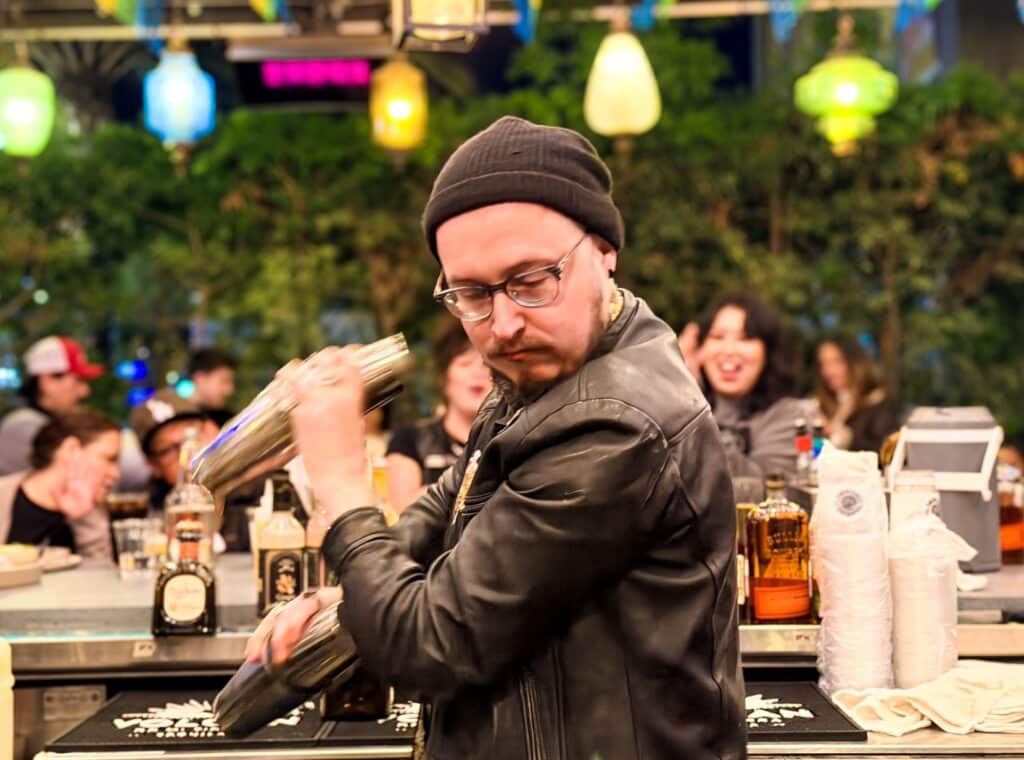
…to tastings and competitions, Long Beach Last Call 2026 was a tangible expression of this city’s love of the industry.
This year saw two cocktail competitions come to life: an all-ladies competition at Port City Tavern, where the competitors, judges, and even the spirit sponsor—Mijenta Tequila—were represented by women. Port City’s own Marilyn Fitoria took the crown, with an incredibly crafted cocktail dedicated to her mother and cafecito time that many Latinos experience growing up. Blending nostalgia, immensely well-crafted storytelling, and unabashed nods toward periods, cramps, and the need for women to connect to one another, it was a particular highlight for me personally.


We also co-hosted the finale of the Buen Provecho Cutthroat Cocktail competition, drawing a boisterous crowd to cheer on four of Long Beach’s finest as they vie for the top spot. In this case, Fairmont Breakers’ Brendon Bos took the top spot.
And in one of our most championed events, we held a “Taste of Mexico” tasting event at Panxa Cocina. Bar manager Bryce Kaesman brought on over 10 stellar purveyors of agave spirits—with brands like G4, Tequila Ocho, Cazcanes, Producer, Rufina, and more appearing—for a well-paced event that proved FOH manager Nikki Floyd and Chef Richie Ramirez are a formidable team.

In the end, Long Beach Last Call 2026 was all about the industry.
My favorite event of each year for Last Call will always be the industry appreciation event. Barbacks. Bartenders. Owners. Brand reps. Distributors. Thanks to the continual love of Gianna Johns and Daniel Flores, owners of Baby Gee, this tradition highlights what we do and who we do it for. Our cocktail community is an economic cog for the city but rarely gets a formal thank you. Thanks to Zachariah Parks of Silvergrin Vodka/Dead of Night Distillery, as well as the crew at Jack Daniel’s, this invite-only party saw hundreds of free cocktails delivered to the ones who make it all happen.
As for next year? Spaces and its workers were palpably more excited at next year’s prospects. With OG heavy-hitters like The Ordinarie’s Christy Caldwell returning to his space, crafters like Colby Sue returning to Long Beach after working in OC, and nearly everyone in the industry expressing interest to help and expand, I cannot wait for 2027.