
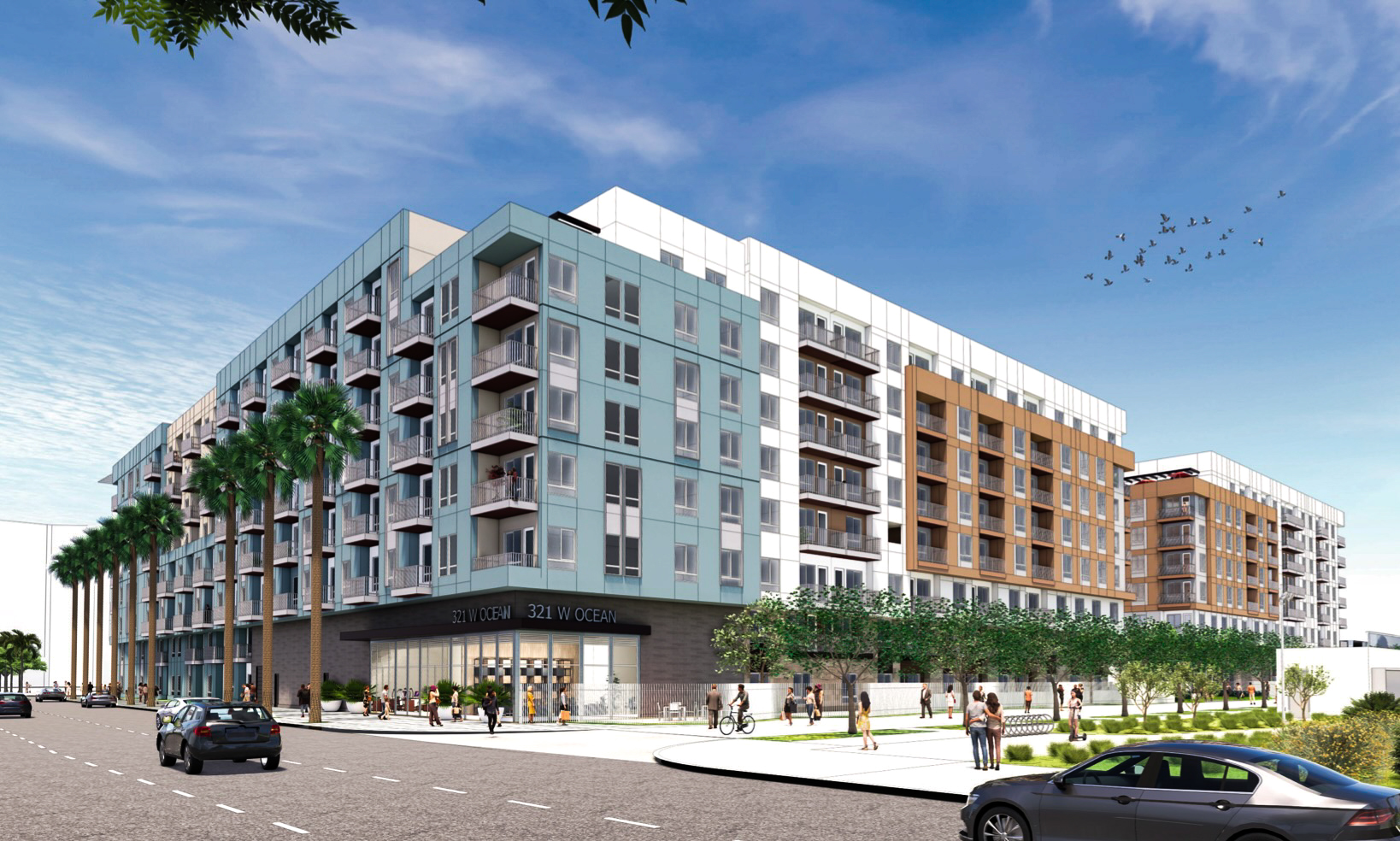
For years, 321 W. Ocean Blvd. has been the most conspicuous empty space in Downtown Long Beach: a fenced-off void between City Hall, Lincoln Park, and Ocean Boulevard where the old Civic Center once stood. Cleared. Excavated. Approved. Promised. And yet stubbornly untouched.
Now, after years of failed attempts to make the numbers work, the long-stalled “Mid-Block” project—the final undeveloped piece of the Civic Center overhaul—may finally be inching toward reality with a dramatically revised proposal that swaps much of its commercial ambition for what developers say is simple viability. More housing. Less retail. Less subterranean cost. And a design built around getting financed in a market that looks very different from what it did when the project was first approved.
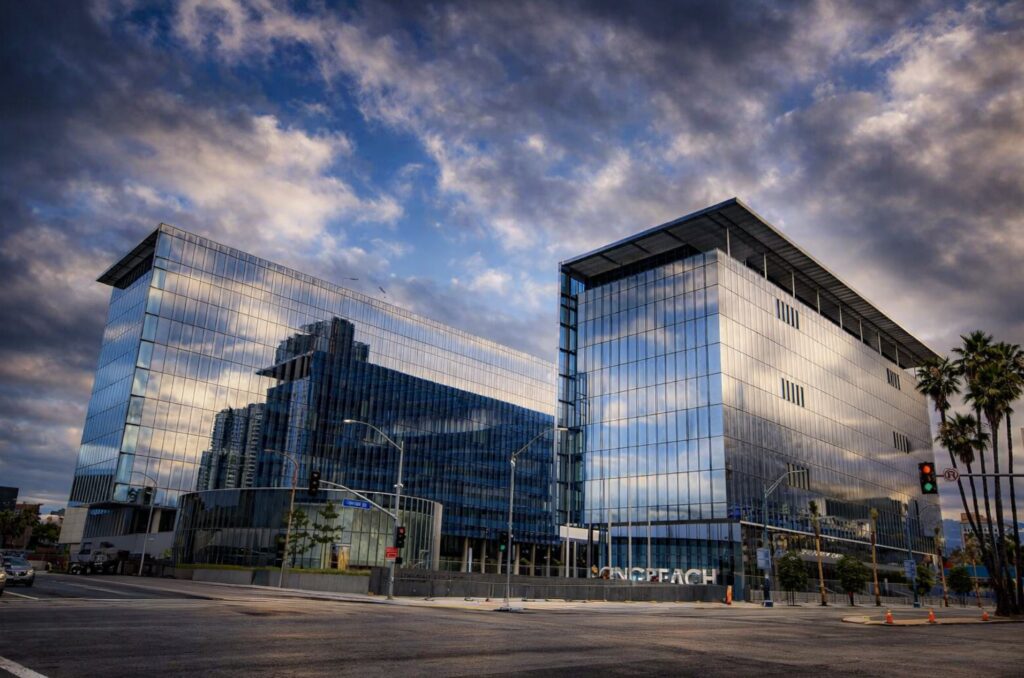
321 Ocean: The last missing piece of the Civic Center
When Long Beach approved its sweeping Civic Center redevelopment in 2015, the vision was grand and city-defining. Demolish the old City Hall. Remake Lincoln Park. Build a new library. Construct a new civic campus. And reshape several downtown blocks in one of the city’s most ambitious public-private undertakings in decades.
Most of that vision now exists in concrete and glass. The current City Hall opened in 2019. The Billie Jean King Main Library followed. The Public Safety Parking Garage rose beside it. Even the residential building at 3rd Street was completed years ago.
But the former City Hall parcel—the center block, the one directly fronting Ocean Boulevard—never came.
Instead, it remained vacant: fenced, dug out, and increasingly symbolic of how hard large-scale housing has become to finance, even in one of the most publicly visible sites in Long Beach.
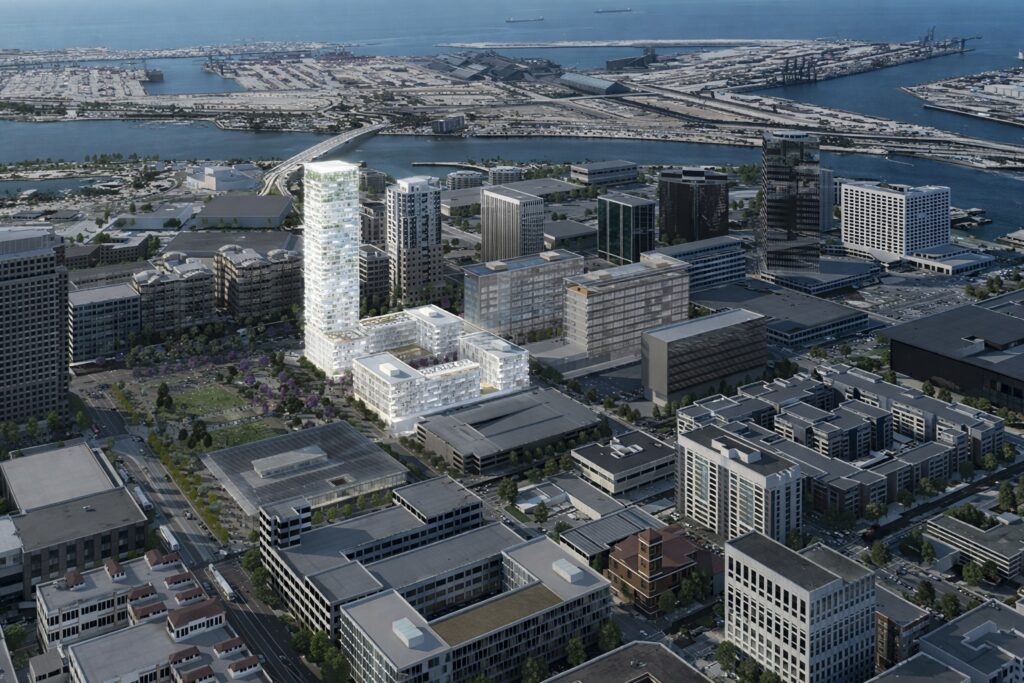
Why the original version never happened
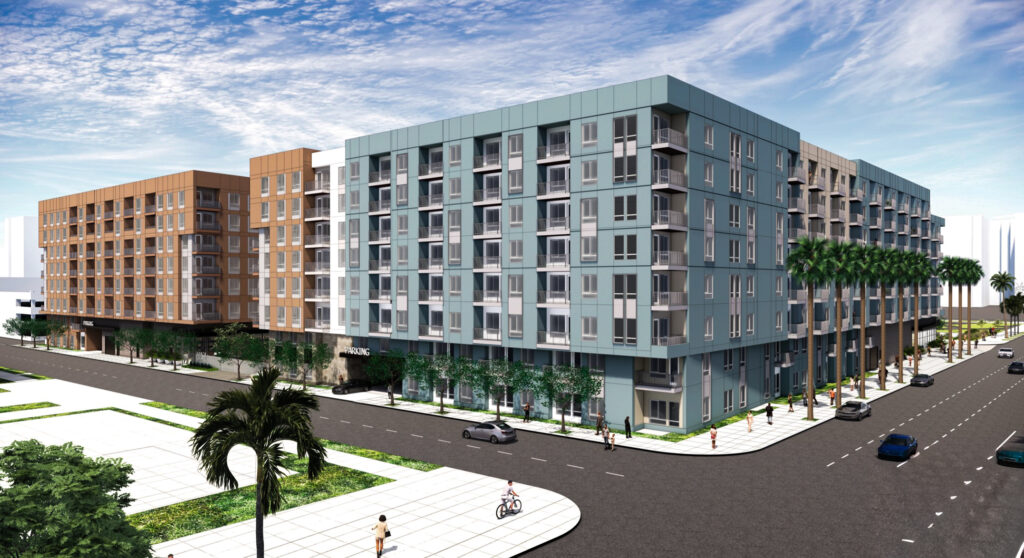
The original project was ambitious: Two structures—one with a tall, hotel-meets-residential tower a la J.W. Marriott at LA Live—with tons of retail. What was eventually approved by the Planning Commission in March of 2020 [pictured below] was much more scaled back. Eschewing the hotel-residential tower, what was envisioned was two eight-story buildings. Those contained 580 apartments, roughly 40,000 square feet of retail and restaurant space, and two full subterranean parking levels stretching nearly across the entire site.
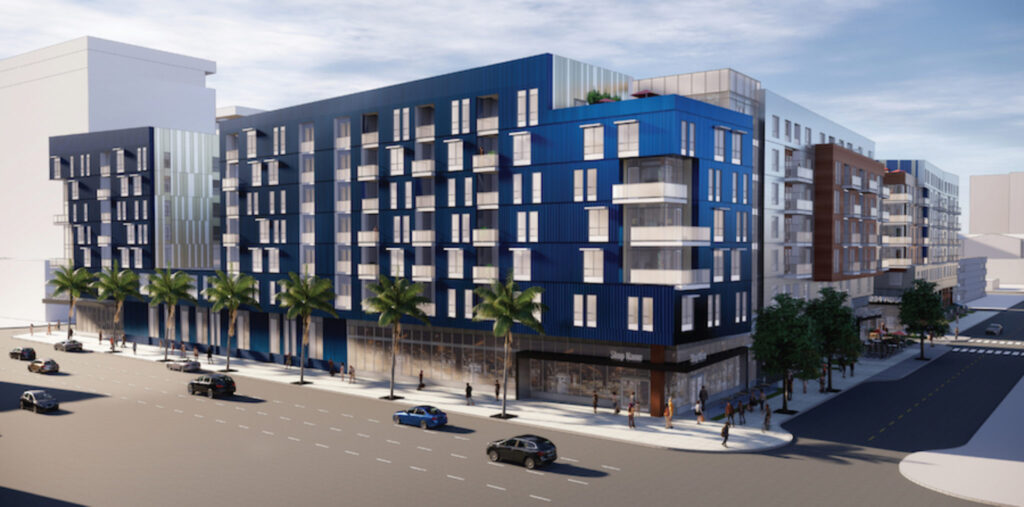
Planning staff say multiple development teams selected over the years were unable to turn that approval into a financially viable construction project. The reasons were predictable but brutal: expensive architectural materials, too much retail in a market that no longer rewards that much ground-floor storefront, and underground parking costs that pushed financing beyond reach.
The new formula: more homes, less burden
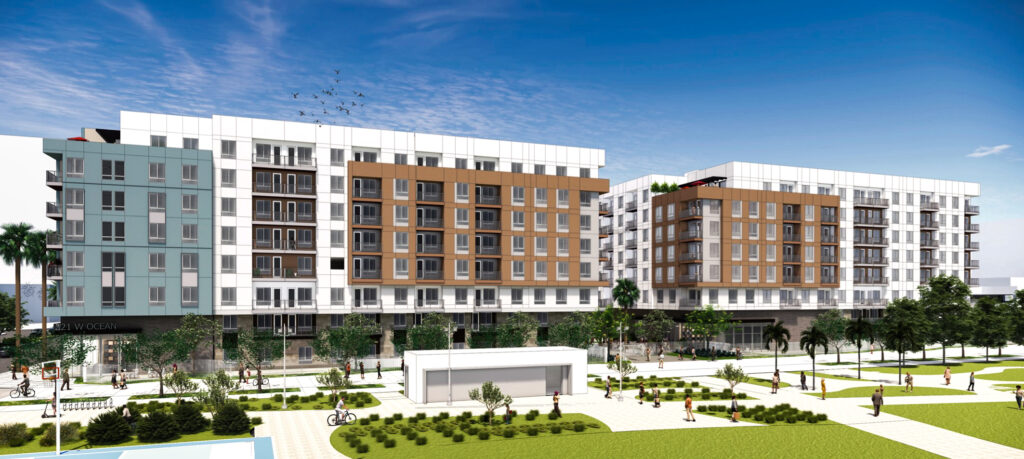
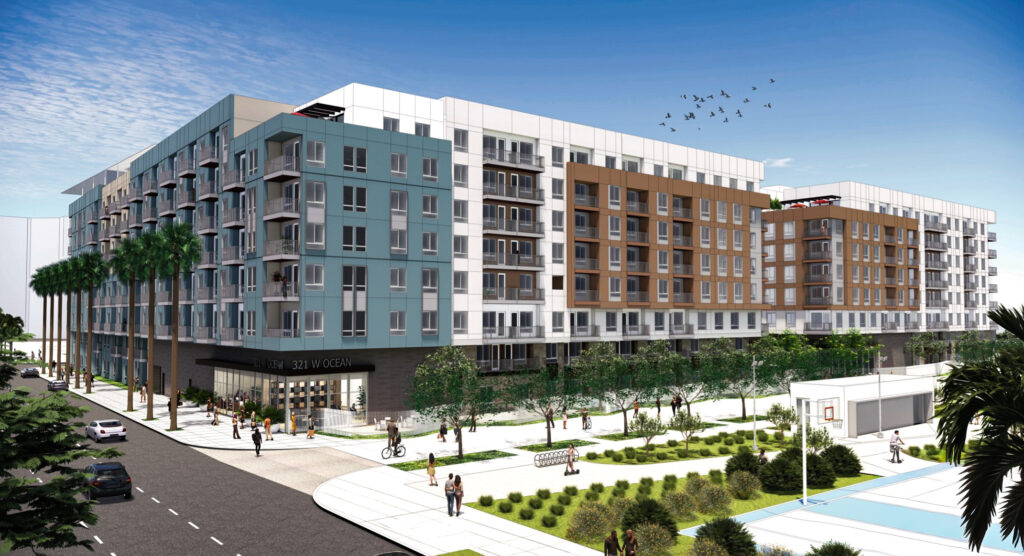
The revised proposal from Mill Creek Residential keeps the basic form of the project intact—still two eight-story buildings—but significantly changes what happens inside them.
Instead of 580 units, the project now proposes 729 apartments: 364 units in the north building and 365 in the south.
That increase comes largely by converting former commercial square footage into housing. Roughly 37,000 square feet of previously planned retail space disappears into residential floor area, allowing many more one-bedroom, two-bedroom, and three-bedroom units while sharply reducing studios.
Average unit sizes shrink, but only modestly—roughly 50 to 60 square feet smaller on average—while the overall residential count jumps enough to make financing more realistic.
Retail shrinks to almost nothing
Perhaps the clearest signal of how much the market has changed: the original 40,000 square feet of commercial space is now reduced to just 2,651 square feet total.
That means what was once imagined as an active retail-lined civic edge now becomes mostly residential frontage, leasing space, fitness rooms, and internal building amenities.
Only one small commercial shell remains planned, tucked into the southwest corner of the north building.
It is not difficult to read between the lines here: downtown storefront demand has not kept pace with older assumptions, and lenders increasingly prefer certainty over speculative retail.
Parking moves upward instead of downward
The other major financial shift happens below—and above—ground. The previous design called for two massive subterranean parking levels. Those are largely gone.
Instead, the revised plan keeps one smaller basement level split into two separate garages, while adding three levels of at-grade and above-grade parking wrapped inside each building’s podium.
Total parking drops from 885 spaces to 817, while bicycle parking far exceeds requirements with 365 bike spaces planned.
Affordable housing remains part of the deal
The affordable housing commitment also remains, though under older terms tied to the Civic Center agreement.
The project will provide 73 moderate-income affordable units—10 percent of the total development—distributed across both buildings.
That falls below what current city inclusionary rules would require if the project were being newly entitled today, but city staff are recommending approval of an alternative compliance method because the site remains governed by agreements dating back to the original Civic Center deal.
Staff also note that Long Beach is currently performing worst in producing moderate-income housing compared with other affordability categories under state housing targets, making these units particularly important from the city’s broader housing perspective.
Cedar Avenue becomes a pedestrian corridor instead of a street
The revised design also quietly reshapes how this part of Downtown will feel on foot.
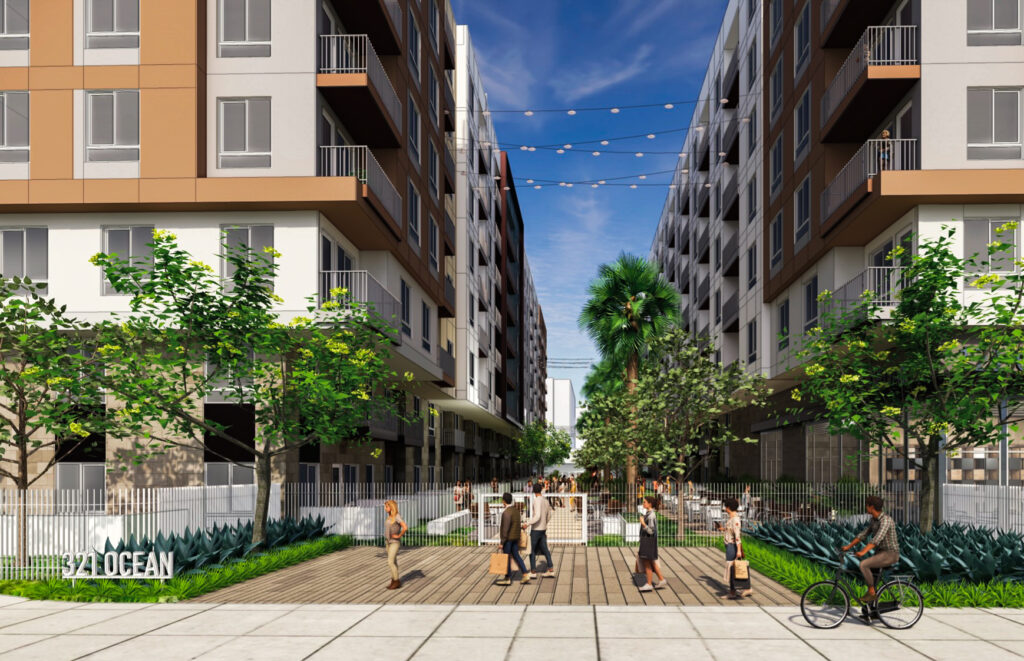
Rather than rebuilding Cedar Avenue as a vehicle street between Broadway and Ocean, the proposal converts that corridor into a landscaped pedestrian paseo linking Lincoln Park, the A Line station area, and Civic Center more directly.
The east-west roadway originally planned between the two buildings also becomes pedestrian-only.
For a site so tied to civic symbolism, planners say that open pedestrian view corridor matters: a visual line from transit to the Civic Chambers meant to reinforce accessibility and openness in the center of government.
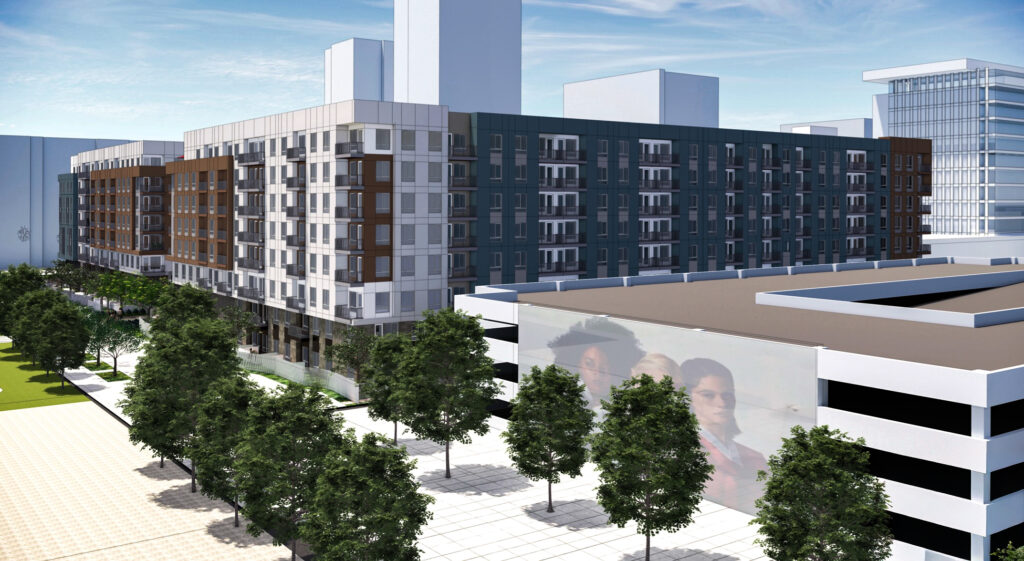
A downtown void Long Beach has watched for too long
For many residents, the old City Hall site has become something more than a vacant lot—it has become a reminder of how unfinished downtown still feels, even after so much of the Civic Center transformation was completed around it.
This latest proposal is less architecturally flashy than the first version, less retail-driven, less expensive in obvious ways. There are, seemingly, more cons than pros.
But perhaps that is exactly why it has a chance. After years of stalled plans, revised math may finally do what ambition alone could not: build the last major missing piece of Long Beach’s civic core. And, though not the most aesthetically pleasing or challenging, more housing.



Add units, decrease parking. That’s very Long Beach.